Finding the Real Context Ceiling: Needle-Benchmarking Forced RoPE Extrapolation
Published revised 5 min read
TL;DR
- I wanted more context on a self-hosted uncensored 35B MoE. Its config looks like it supports 256K, but the real text window is 32K.
- Forcing vLLM past that (
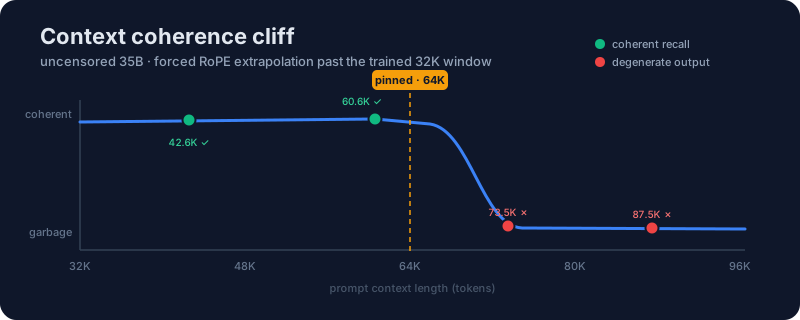
VLLM_ALLOW_LONG_MAX_MODEL_LEN=1) let it load at 64K and even 96K — no errors, no OOM. - But "it loaded" is not "it works." A progressive needle-in-haystack bench showed output stays coherent to ~60K and then falls off a cliff into
!!!!!garbage. - The longer runs failed retrieval without exhausting VRAM. I configured a 64K lane after passing the checks below and kept the benchmark for future model evaluations.
The setup
One of my daily-driver lanes is a quantized 35B Mixture-of-Experts model with a multi-token-prediction draft head, served on a single 24 GB AMD card via vLLM. It shipped at a 32K context window. The ask was simple: can we make it bigger?
The first surprise was in the model config. It advertised two different limits:
{
  "max_position_embeddings": 262144,        // top-level — looks like 256K!
  "text_config": {
    "max_position_embeddings": 32768        // the real text window
  },
  "vision_config": { ... }                  // this is a multimodal config
}
That top-level 262144 is the vision envelope, not the text RoPE. vLLM correctly derives the text model's max_model_len from the nested text_config value: 32768. Ask for more and it refuses:
User-specified max_model_len (65536) > derived max_model_len
(max_position_embeddings=32768). VLLM_ALLOW_LONG_MAX_MODEL_LEN must be
used with extreme caution...
Lesson one: when a model claims a giant context, check whether that number is the text window or a multimodal envelope. They are frequently not the same.
Forcing it open
The model's RoPE base frequency (rope_theta) was set to 10,000,000 — an aggressive value associated with long-context extrapolation. That made it plausible the model could run past its declared 32K even though it was never trained there. So I forced the door open with VLLM_ALLOW_LONG_MAX_MODEL_LEN=1 and asked for 64K.
It loaded. Short prompts answered fine. vLLM reported healthy KV headroom (2.91× concurrency at 64K). Easy win, right?
This is the trap. A model that loads at a longer context will happily accept long prompts and emit confident-looking tokens — whether or not those tokens are correct. RoPE extrapolation past the trained window doesn't throw an exception; it silently degrades. You cannot see it in a health check, a short smoke test, or a metrics dashboard. You can only see it by asking the model to use the long context and checking the answer.
The bench: a needle in a growing haystack
So I built a progressive needle-in-haystack coherence test. The recipe is deliberately boring:
- Plant a unique fact at the very start of the prompt: "The vault override passphrase is MARMALADE-73118."
- Pad with filler until the prompt hits a target token count.
- At the very end, ask the model to repeat the passphrase verbatim, at temperature 0.
- Pass = the exact needle comes back. Fail = wrong answer, or degenerate output.
Because the needle sits at the start and the question at the end, a pass requires the model to attend coherently across the entire window — exactly the thing RoPE extrapolation breaks. I swept the target length upward:
| Prompt tokens | Result | Output |
|---|---|---|
| 42,649 | ✅ PASS | exact recall |
| 60,589 | ✅ PASS | exact recall |
| 73,469 | ❌ FAIL | !!!!!!!!!!!!!!!!!!!! |
| 87,499 | ❌ FAIL | !!!!!!!!!!!!!!!!!!!! |
There it is. Coherent to ~60K, then a hard cliff between 60K and 73K into pure degenerate repetition. And to be explicit about the headline finding: I also tried 96K. It loaded cleanly — vLLM reported 2.01× KV concurrency, zero OOM. And every long generation past ~64K was garbage.
The observed failures happened without an out-of-memory error. They are consistent with a model context limit under forced rotary position embedding (RoPE) extrapolation. I did not test every concurrency level, so this does not establish that hardware or runtime settings are irrelevant to all longer-context runs.
Where we landed
I configured the lane at 64K based on the retrieval checks below and the runtime’s reported key-value (KV) cache headroom. That doubles the configured window from 32K. The longest passing prompt reported below is 63,172 tokens; it does not validate every task or every token up to the configured limit.
Update, November 2026: in July the 64K lane hit a prefill workspace limit in the model's hybrid layers, separate from the retrieval cliff measured here. The fix reserved headroom: one concurrent sequence instead of two, and GPU memory utilization lowered from 0.98 to 0.90. So the 64K window held, at half the concurrency this post assumed.
The probe is now a checked-in tool, context-needle-bench.py:
# explicit points
context-needle-bench.py --base-url http://localhost:8000 --model my-model \
    --points 32k,48k,64k,80k,96k

# progressive sweep, stop at first failure
context-needle-bench.py ... --points 32k,64k,96k,128k --stop-on-fail

# binary-search the exact cliff
context-needle-bench.py ... --bisect 64k:128k --bisect-tol 8k

# depth grid: one needle at several depths -> length x depth recall grid
context-needle-bench.py ... --points 48k,60k,73k --depths 0,25,50,75,100

# multi-needle: N labeled facts spread across one prompt, recall all of them
context-needle-bench.py ... --points 48k,60k --needles 5
It has no third-party dependencies, so it runs anywhere — including inside a serving pod, straight against localhost:
kubectl exec -i <pod> -c model -- python3 - < context-needle-bench.py -- \
    --model my-model --points 48k,64k,80k
But is one needle enough?
A single fact at the very start of the prompt is the easy case. Two failure modes it doesn't catch: a model that loses the middle of a long context (the well-documented "lost in the middle" effect), and a model that can echo one fact but falls apart tracking several at once. If 64K is going to be a real working window, it has to survive both. So I extended the bench and pointed it back at the live model.
Depth grid — same needle, planted at 0%, 25%, 50%, 75%, and 100% of the context:
len \ depth     0%    25%    50%    75%   100%
     49152      ✓      ✓      ✓      ✓      ✓
     61440      ✓      ✓      ✓      ✓      ✓
The depth sweep passed at every tested position. It did not reveal a middle-position failure at those prompt lengths. Other prompts, lengths, or workloads could behave differently.
Multi-needle — five distinctly labeled passphrases scattered across one prompt, with the model required to return all five:
| Prompt tokens | Needles recalled |
|---|---|
| 50,315 | 5 / 5 |
| 63,172 | 5 / 5 |
The model returned all five facts from the 63,172-token prompt. That is useful retrieval evidence, though it does not establish reliable long-context reasoning, tool use, or summarization.
Two new modes in the bench (--depths, --needles) make both of these one-liners, so the next forced-extrapolation lane gets the same treatment for free.
The takeaway
Three checks I will keep:
- Read the nested config. A top-level
max_position_embeddingscan be a multimodal envelope. The text window may be far smaller. - Never trust "it loaded." Forced RoPE extrapolation fails silently. Loading, passing a health check, and answering a short prompt tell you nothing about whether the long context is usable.
- Pin to what you proved, not what fit. VRAM will happily let you allocate a context the model can't think in. Benchmark coherence, find the cliff, and pin below it.
Borrowed context length has a short half-life, too. Measure it before you depend on it.
Related posts
12 min read
Twin Life on a Doubled Pool: One Day of Canary-Driven Inference Engineering
A twin-lane canary promoted prefix caching, FP8 KV cache, and a larger context pool while catching five regressions before they reached the primary workload.
Shared tags: flexinfer · vllm
6 min read
Standing Up a GPU-Ready Private AI Platform (Harvester + K3s + Flux + GitLab)
Field notes from building and operating a small private GPU platform with Harvester, K3s, and a GitLab -> Flux delivery loop.
Shared tags: inference
7 min read
The Factory Upgrades Its Own Foundation: An MCP Spec Marathon
MCP shipped a breaking specification revision. I wrote the gap analysis and filed it as backlog for Mills, which merged the SDK half of the migration on August 26.
Comments
Join the discussion. Be respectful.